Lakes
Many wine regions are located not just by rivers but also lakes, which can have a profound effect on growing conditions. Most often, in cooler climates they retain heat during the day and release it at night to aid ripening; they also reflect sunlight back on to the vines trained on the banks and slopes of the lake. In humid conditions, the water forms part of the process in the development of botrytis. Much of the time, they’re beautiful which attracts tourists and aids the local wine and hospitality industry.
Neusiedlersee (Austria)
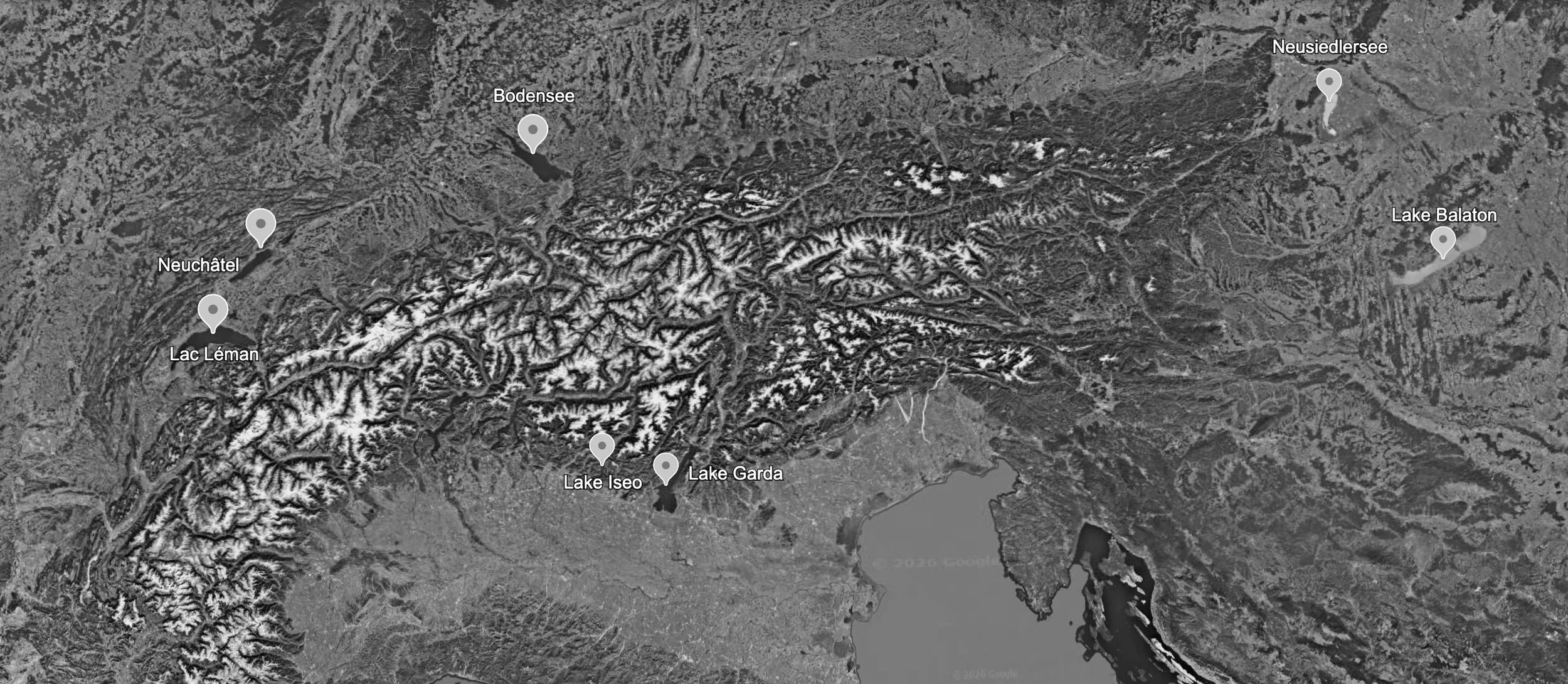
One of the strangest lakes in the world, on average one metre in depth, getting as deep as 1.8m. It’s mostly in Austria, though some of it is also in neighbouring Hungary. It’s 36km in length and between six and twelve in width. Although the climate is cool continental, it gets humid and great sweet wine is regularly produced from grapes affected with noble rot. The most famous of these is Ausbruch, from the village of Rust on the western side of the lake. There is also Beerenauslese and Trockenbeerenauslese, much more common and less expensive than their German equivalents because of the lake, marshes on the edge of the lake, and humidity.
Surrounding the lake are three DACS: Neusiedlersee on the east, Neusiedlersee-Hügelland on the west, and Mittelburgenland to the south going towards Hungary. Besides great sweet white wine, the three main black grape varieties of Austria— Blaufränkisch, St-Laurent, Zweigelt—are all grown here on gentle slopes that also have an Alpine influence.
(It’s worth noting that See in German means lake, but the water in Neusiedlersee is saline just like in a sea.)
Lake Balaton (Hungary)
The largest freshwater shallow lake in Europe, Lake Balaton isn’t far from Neusiedlersee. It’s not quite as shallow, around 3.2m in depth, which gives some extra warmth for the wine regions mostly on its north side with south-facing slopes to capture the sunshine. The lake was an attraction for the aristocracy, with many exclusive resorts that also began to attract the middle-class in the nineteenth century. In the 1950s, the Communist government encouraged tourism around the lake and it became a central part of the local economy. Because of all these visitors, over the centuries, the wines—made since Roman times—were well-known within Hungary but lesser so outside the country.
The growing conditions are warm in the summer with cool, wet winters, making the climate similar to the Mediterranean. The soils are often volcanic, especially on the northern slopes, which, alongside the warming effect of the lake, helps produce fuller, richer wines that still have a crisp, fresh acidity.
There are several wine regions around the lake. Transdanubia lies between Balaton and Neusiedlersee, where wines are similar in style and varieties as the Austrian lake. On the northern side of Balaton are Badasconyon, where the volcanic soils and the influence of the water produce powerful white wines, and Balatonfüred-Csopak, where the soils are slate. Somló is on the slopes of an extinct volcano; an historic region which is gaining more international interest for elegant, ageworthy white wines (the wines of Somloí Vandor are absolutely worth seeking out). On the southern side of the lake—which is more known as a tourist destination—is Balatonboglár where the soils are sandy and loess-based, mostly for white wine with some Merlot and Pinot Noir.
This vast lake, in the combination of different soil types, mesoclimates caused by the water, and varied aspects on the slopes, has seen wine made for millennia. The clampdown on Hungarian wine under Soviet rule meant that the wine industry fell away, but there are some interesting producers reviving the reputation of Balaton which hopefully will be found more often internationally.
Bodensee (Germany, Switzerland, Austria), Neuchâtel (Switzerland), & Lac Léman (Switzerland)
Lake Geneva
In Switzerland there are two cantons (semi-autonymous counties) connected to Lac Léman (Lake Geneva in English). Vaud is the more important, with steep slopes rising above the northern shores of the lake. Within Vaud, there are six regions and 26 villages, two of which are designated Grand Cru. These steep slopes above the lake allow the grapes to ripen in a borderline climate, producing wines from Chasselas which can be firm and powerful.
Geneva—the name of a canton as well as the city—is smaller and more directly connected to the lake. Plantings are on flat vineyards, which also receive plenty of sunshine. Most importantly, the proximity to the lake prevents spring frost from settling, due to the water’s warming influence. Again, Chasselas (also called Fendant in Switzerland) dominates.
Neuchâtel is a long, thin lake between France and Germany. There’s a little wine made on steep, south-facing slopes along the lake on old, chalky soils. There’s an unusual style of wine made from Pinot Noir, which is pale pink, called Oeil de Perdix, an echo of the wines once made in Champagne.
Bodensee (Lake Constance in English) is a large lake on the border between Switzerland and Germany—where it’s more important for grape-growing. Plantings on the northern side of the lake are located in Baden, a spread-out German region which is the country’s warmest. Bodensee itself is the warmest area for grape-growing in Germany, which means that it’s well-suited to the national trend for red wine. That’s made further possible by the lake effect and slopes. Across the Swiss border is the small St. Gallen region (called Rheintal in German), which is a valley between the lake and the Rhein. There’s also an unofficial region in Austria called Bergland with high altitude plantings above the lake, which helps moderate temperatures for ripening. Although these are not significantly major international regions, they have an historic place in their countries’ wines, the lake giving the vines a chance in a cool climate.
The Italian Great Lakes
The Great Lakes of Italy are north of Milan in the foothills of the Alps, where Mediterranean Italy moves towards central Europe. There are many wine-making areas connected to the lakes, but two of the lakes are of particular significance.
Iseo is one of the smaller of the Great Lakes, in wine terms best known for Franciacorta, the sparkling wine made in the traditional method. Grape-growing here goes back centuries, but it was only in the 1960s that producers began to focus on quality bubbles. The vines are planted on gentle slopes on the southern banks of the lake, though they can’t be planted higher than 500m otherwise the grapes won’t ripen. Together with the Alps, the lake provides a cooling influence in the moderate continental climate, allowing the production of high-quality sparkling wine.
Garda is spectacularly beautiful, its pristine blue water sitting below the Alps and surrounded by idyllic northern Italian villages on its banks. The south edge of the lake is everything we imagine about Italy, while the northern tip suddenly becomes German: the lake is a geographical feature which marks a cultural and political change.
The lake also attracts many—too many—tourists, so it’s perhaps surprising that its wines aren’t better known; that’s perhaps because they’re mostly drunk locally. A favourite white wine is Lugana, on the southern tip of the lake. The vines are planted on a flat glacial plain, a continuation of the lake beneath the Alps. Garda cools the growing conditions, breezes coming in to moderate the sunny warmth of the day. Made from Verdicchio (locally called Trebbiano Di Lugana), the wines are round and with substance, but with wonderful freshness. Bardolino is just around the corner, on the south-eastern banks of the lake. These are light-bodied, pale-coloured red wines best served slightly chilled.
Not too far from the lake are Soave and Valpolicella; though less influenced by Garda, the sandy soils of Soave come from the lake, while the best wines are from volcanic soils on slopes that stretch along the lake into Trentino and then Alto Adige into the Alps.
Finger Lakes
When the east coast of what is now the USA was settled by the pilgrims, they planted vitis vinifera cuttings they’d brought with them. They just wouldn’t ripen in the cold, harsh climate—but no matter, there were already vines growing that were native to the area. They just didn’t lead to very good wines and wine production stalled for the best part of 300 years.
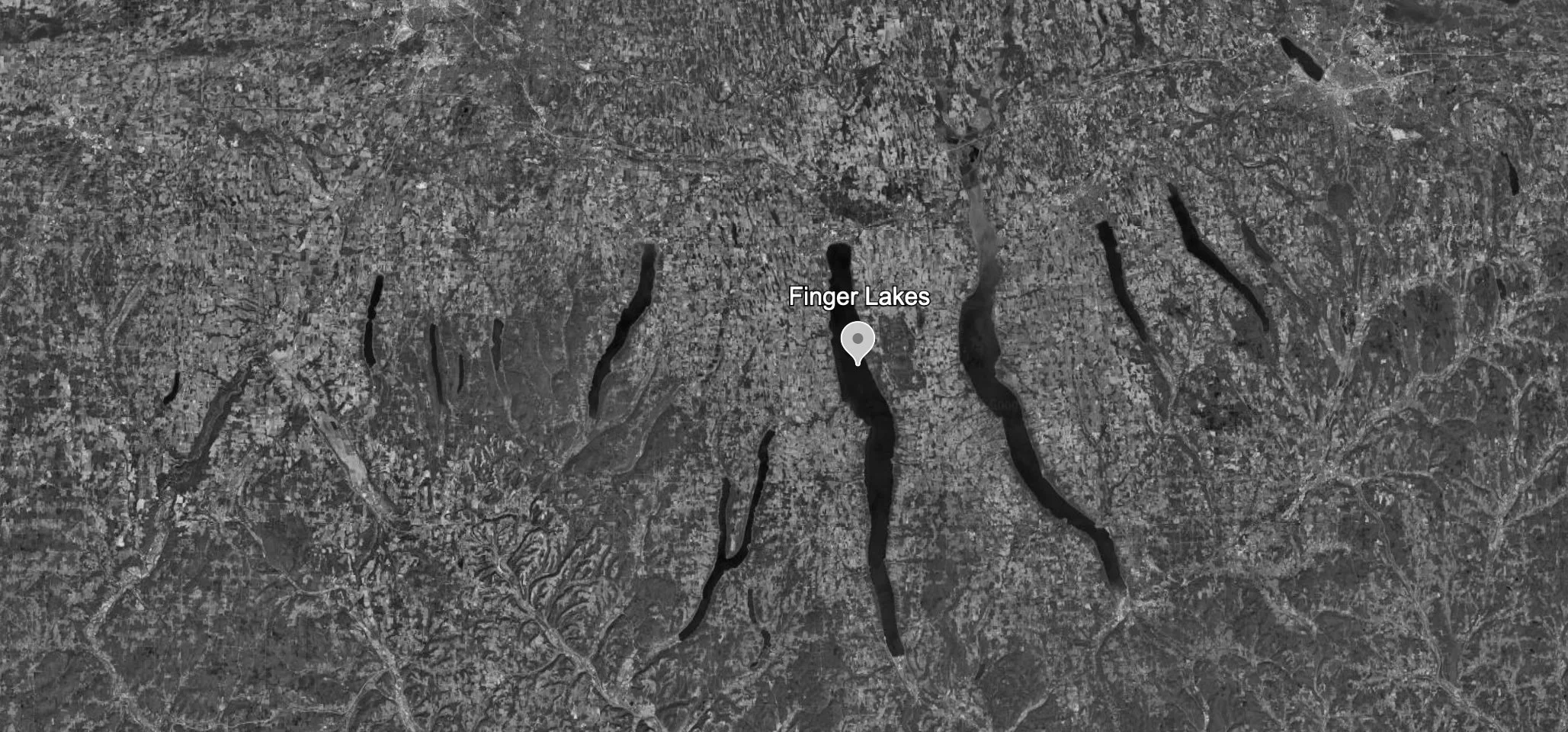
In the 1950s, a German winemaker, Dr. Konstantin Frank, was determined to make quality wine from vitis vinifera. For his plantings of Riesling, he chose the Finger Lakes, a series of 11 lakes that look like, well, fingers.
They’re all important for wine production as the lakes are extremely deep: most vineyards are located on slopes above the deepest lakes which reflect sunlight on to the stony soils and retain and radiate heat to aid ripening. Cayuga has a depth of 133m, Seneca nearly 200m, the floor of both lakes below sea level—quite different from the lakes of Austria and Hungary.
The Great Lakes of USA/Canada
The Finger Lakes are south-east of the Great Lakes which form the border between the US and Canada. Lake Erie is the largest AVA in New York State, though mostly for production of inexpensive wine from hybrids (despite the lake effect, full ripeness for vitis vinifera remains difficult).
On the other side of the border in Ontario, the Niagra Peninsula is the most important wine-producing region in Canada. It’s protected from cold continental winds by Lake Erie and Lake Ontario, in what would otherwise be an extreme climate. The growing seasons are hot but short; not only is there world-class ice wine made here, there’s some very fine Chardonnay.
Also of increasing interest are the wines of Michigan, the vines planted right next to the lake which moderates the cool continental climate. The region attracting most attention is Leelanau Peninsula, producing different styles of wine from both vinifera and hybrid varieties.
Central Otago (New Zealand)
Another cool continental climate, but the lake effect is a little different. Lake Dunstan was created by the construction of Clyde Dam in the early 1990s—all of the power on the South Island is hydroelectric. This resulted in the controlled flooding of the small town of Cromwell which is in the centre of Central Otago, the old houses now underwater. The creation of the lake also changed growing conditions, forming vineyards with different aspects with varied influence coming from the water. Rather than water indirectly creating soil types, in this case water either exposed or covered various soils. As Central Otago is such a young wine region, this relatively new lake has a dynamic influence on how the wines develop in the future.
Lake Sonoma (California)
Another artificial lake, this time created by the US military in the 1950s. Unusually for a human made lake, it’s very deep and therefore cold. California is famous for its morning fog, but in Lake Sonoma the influence of fog is quite particular. The fog hangs directly on top of the lake, meaning that vineyards above the lake aren’t affected by the fog—“above the fog line” as it’s termed. This changes growing conditions: exposure to sunshine, but cooler nights due to plantings of over 350m. The AVA is Rockpile, for full-bodied but very measured Zinfandel and Cabernet Sauvignon.
All of these lakes, often found in a cool climate, have an important geographical influence on grape-growing which has led to distinctive local wines. Those wines have also been shaped by tourism, as the beautiful lakes are get-aways for city-dwellers going back to aristocractic times. Tourism buoys the local economy, which wine forms a part of. In this, nature plays a vital role in not just making viticulture possible and creating a specific style of wine, but also to give a compelling reason for people to visit the region and drink that wine. After all, is there any greater feeling than having a glass of chilled white—or red—wine while sitting by Lake Garda?