The Danube & The Black Sea
The Danube is the second longest river in Europe, at around 2,850km, starting in the Black Forest in south-west Germany and ending in the Black Sea between Ukraine and Bulgaria. It passes through ten countries, cutting its way through many political histories as well as wine regions which are better or lesser known.
The cultural diversity of the Danube is seen in its many names; besides its overarching English name, it’s Donau in German, Duna in Hungarian, Dunaj in Slovak and Czech, Dunav in Serbian and Croatian, Дунав (doo-nav) in Bulgarian, Dunărea in Romanian and Moldovan, and Дунай (dan-ube) in Ukranian. All of those countries have seen tumultuous histories (the river was the Roman frontier), continuing to the modern day—the Danube has witnessed a lot over the centuries. But how has it affected grape growing?
austria
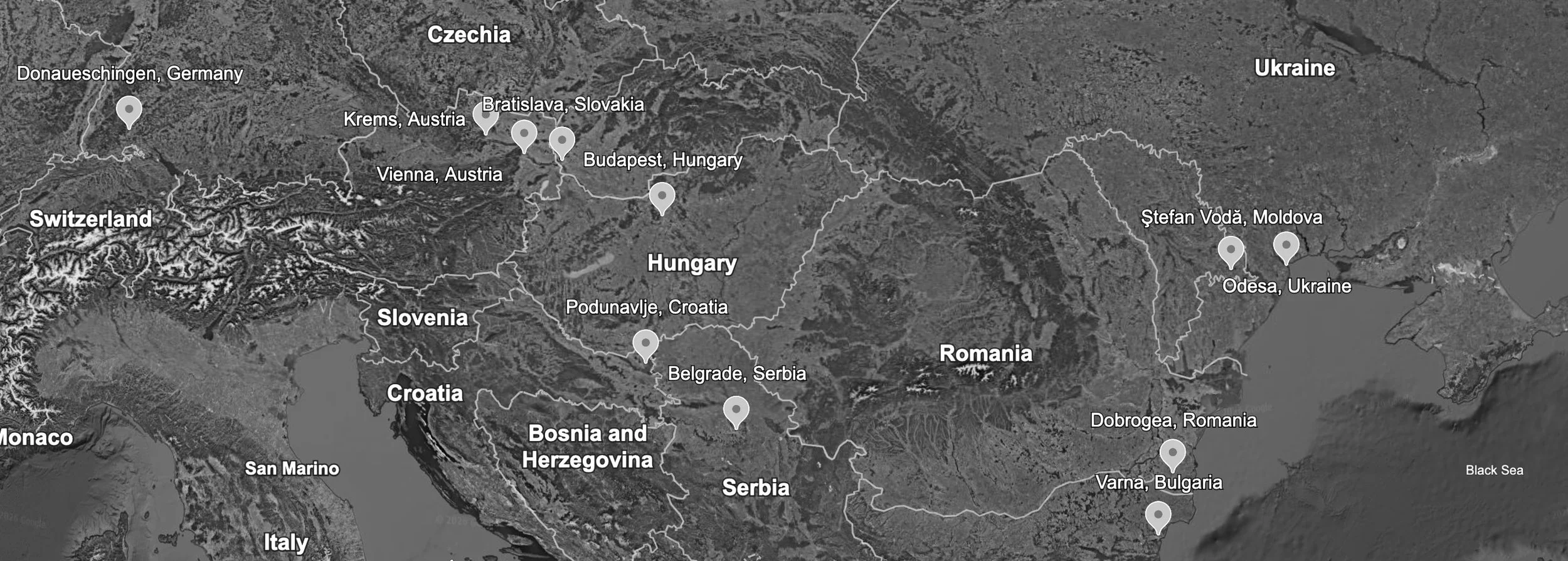
Despite the fact the river starts in Germany in the Baden region, there is no wine made near its banks as it flows eastwards between mountains that separate Württemburg and Switzerland. It continues into Austria, where it has an important influence on the three closely associated areas of Wachau, Kamptal, and Kremstal. The former two are directly on the banks of the river; in Wachau, there are steep terraced slopes rising up from the river, while on the other side in Kamptal the vineyards are more gently undulating. Kremstal is a little further away from the Danube, around its small tributary Krems. In Wachau, where the slopes are steeper, and Kamptal the soils are loess based, radiating heat from the sunlight, which is also reflected by the river. The soils in Kremstal are more clay and limestone, producing weightier wines. The vineyards of all three small regions have been mapped out, showing their relation to the river and how it subtly affects grape-growing according to soil, aspect, and elevation.
The next major wine region on the Danube’s journey is Weinviertel (literally Wine Quarter) where the soils around the river are much more fertile and alluvial. Not far from the capital city of Vienna, Weinviertel provides Austria with good-quality wines, far less concentrated than those which come from the steep slopes of Wachau et al. The river then flows through Vienna and into the capital city of Slovakia, Bratislava.
slovakia
Roughly four-fifths of Slovakian wine is made in regions connected to the river. Perhaps because I grew up in the 1980s, I think of Germany and Austria as western Europe, but really they are central Europe and more connected to countries such as Slovakia, Czechia, and Hungary than we think, and Danube’s journey through all these countries reflects this. At the same time, those countries which spent the second half of the twentieth century under Soviet rule found their wines more neglected than those that exited the Second World War into democracy. Slovakian wine is gaining some traction internationally, in part because they remain connected to the tradition and history of previous generations.
Južnoslovenská is a region on the southern plains near the Danube, where it’s warm, flat, and dry. In contrast, the vineyards of Malokarpatská are on the foothills of south-facing slopes with limestone soils on the Danube and Morava rivers, which is also found in neighbouring Czechia. There’s one other major region, Nitrianská, which is connected to a different river, the Nitra. This is a basin where there are varied local climates on the undulating hills.
hungary
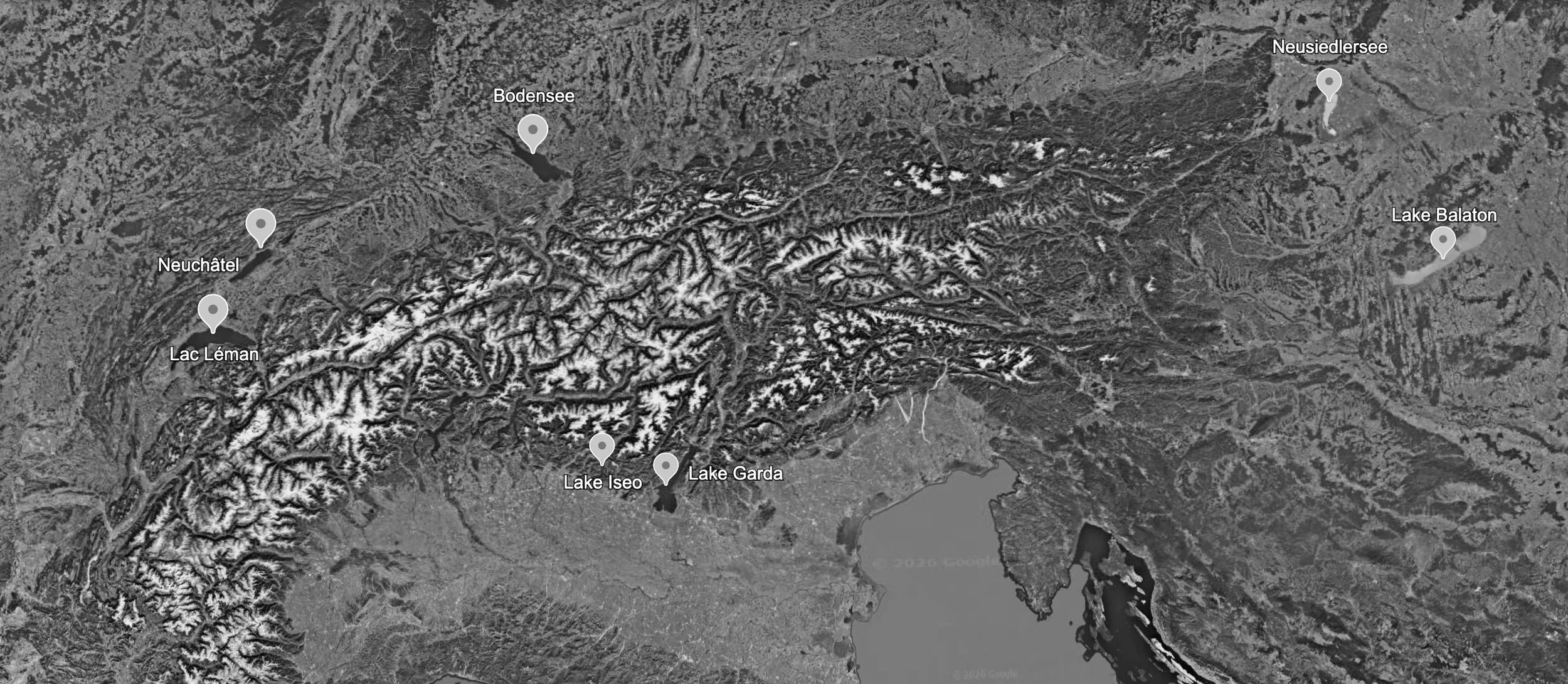
The Danube divides Hungary in two, just as it separates the two historic cities that form its capital, Buda and Pest. Hungary is of course best known for Tokaji, which comes from volcanic soils in the north-east of the country, but there are plenty of other wine regions. Dunántúl (Transdanubia) lies on plains between the Danube and the two shallow lakes of Neusiedlersee in Austria and Lake Balaton within Hungary, the soils becoming more volcanic towards the latter lake, while Észak-Dunántúl is closer to the Danube with limestone for white and sparkling wines. Alföld (Great Hungarian Plain) is a vast plain between Danube and Tisza (Hungary’s second river) south of Budapest. Due to the influence of the rivers the soils are sandy soils which, due to the absence of phylloxera, led to a lot of plantings in the region. As the land is flat, mechanisation is commonplace and production is generally high, although there are pockets of quality. As the river moves towards eastern Europe, the climate becomes warmer and more extreme: spring frost and hot summers are two growing issues.
croatia
The Danube, as it snakes south from Budapest, forms the border between Croatia and Serbia. Croatia’s climate in terms of wine can be divided in two: coastal on the Adriatic with hundreds of islands and inland and continental—which is where the Danube wine regions are found. Podunavlje is in eastern Croatia along the Danube, Drava, and Sava rivers. Within the area are the sub-regions Ilok, Baranja, and Erdut, where the winters are cold, the summers hot, and the soils volcanic. Edrut, in particular, is on steep slopes above the Danube and is most known for white wine.
serbia
The Danube visits four capital cities: Vienna, Bratislava, Budapest, and finally Belgrade. Many of Serbia’s wine regions are located near Belgrade. To the west is Fruška Gora, a large mountain directly overlooking the river. It’s the centre of wine production, with both traditional and modern wineries. Moving out of Belgrade to the east is Smederevo, also along the Danube. Towards Romania is Vršac, just north of the river on the foothills of the mountains.
romania
The Danube heads towards the Black Sea, and the merging of these two bodies of water becomes important for the wines of Romania, Bulgaria, and Ukraine. In Romania, the very sunny region of Dobrogea is between the Danube and the Black Sea, where there are several sub-regions including Murfatlar (where sweet wine is a speciality), Babadag, Adamclisi, and Sarica Niculițel (arid and continental, overlooking both the Danube and the Tuclea rivers). The Black Sea brings in cooling breezes and the lake effect also leads to the production of sweet wine, sometimes from botyrtis but usually late harvest.Terasele Dunării is located along the Danube, where the soils are sandy for aromatic white wines. Muntenia and Oltenia Hills are along the Danube on the slopes of the Carpathian mountains. Banat is further away from the Black Sea, connected to Serbia in south-west Romania, also influenced by the Danube.
moldova
This small country, which has a difficult relationship with both Romania and Russia, makes interesting wine which would be better known if the country had more international clout. Besides the Danube, there are three other important rivers: Dnestr, Prut, and Reut. Stefan Voda is near the Danube Delta and Black Sea, where the Dniester and Dnieper rivers also affect local growing conditions.
bulgaria
The Danubian Plain is along the Danube River in northern Bulgaria, where 30% of the country’s vineyards are located, with a temperate continental climate with hot summers and cold winters. In both Bulgaria and Ukraine, the Black Sea becomes especially important, the Danube being one of 25 major rivers that flow in the saline body of water. The Black Sea channels cool currents that come in from northern Europe, making growing conditions more moderate than the more extreme continental climates of the Danube in eastern Europe. In Bulgaria, Varna/Dobrich is located around the town of Varna where the cool summers produce fresh white wines. To the south of the Black Sea is Burgas/Pomorie which extends to the Turkish border where it’s a lot hotter in the summer and dry in the autumn.
ukraine
Danubian Bessarabia (or Southern Odesa) is the prime region in Ukraine. It’s in the southwestern corner of the Odesa Oblast, stretching from the Danube River into the Tylihul Estuary. Vineyards are located along terraces and also near Lake Yalpug; soils are sandy and the warm summers are cooled by both the Danube and the Black Sea. Over 60% of Ukraine’s wine production is connected to the Black Sea with warm continental conditions cooled by the maritime influence of the sea. The Black Sea also allows for mild winters and soils are often sandy and limestone, although the regions are also strongly associated with the black soil (chernozem) that comes from the sea. Although Bulgaria, Moldova, and Ukraine are not foremost associated with wine, there are an astonishing number of bodies of water that make quality wine production possible.
Perhaps no other river incorporates so many wine styles as the Danube. It passes through ten countries and the climate changes from cool to moderate to warm continental, with many local influences along the way. Soil types change alongside weather conditions and everything is made from dry, crisp to full-bodied whites to sweet wine to sparkling to full-bodied reds. These regions may not be on the international radar, but like the Danube itself they have plenty of history.
to learn more about the Danube and its influence on all these wine regions, listen to the podcast on patreon.com/mattswineworld