Bordeaux Rivers & Burgundy Streams
The rivalry between Bordeaux and Burgundy is historic and sometimes intense: which one of them is the greatest region in France? That’s all down to personal taste, but personal taste can get quite opinionated! It’s also quite an unhelpful comparison, as the two regions are quite different: a continental versus maritime climate; Pinot Noir and Chardonnay, Cabernet Sauvignon, Merlot, and white blends; the Cru system; their current and historic markets. But one aspect that the regions share but gets overlooked is water. In Bordeaux, the influence of water is quite apparent; in Burgundy, it gets forgotten but in very different ways is equally important.
the rivers of bordeaux
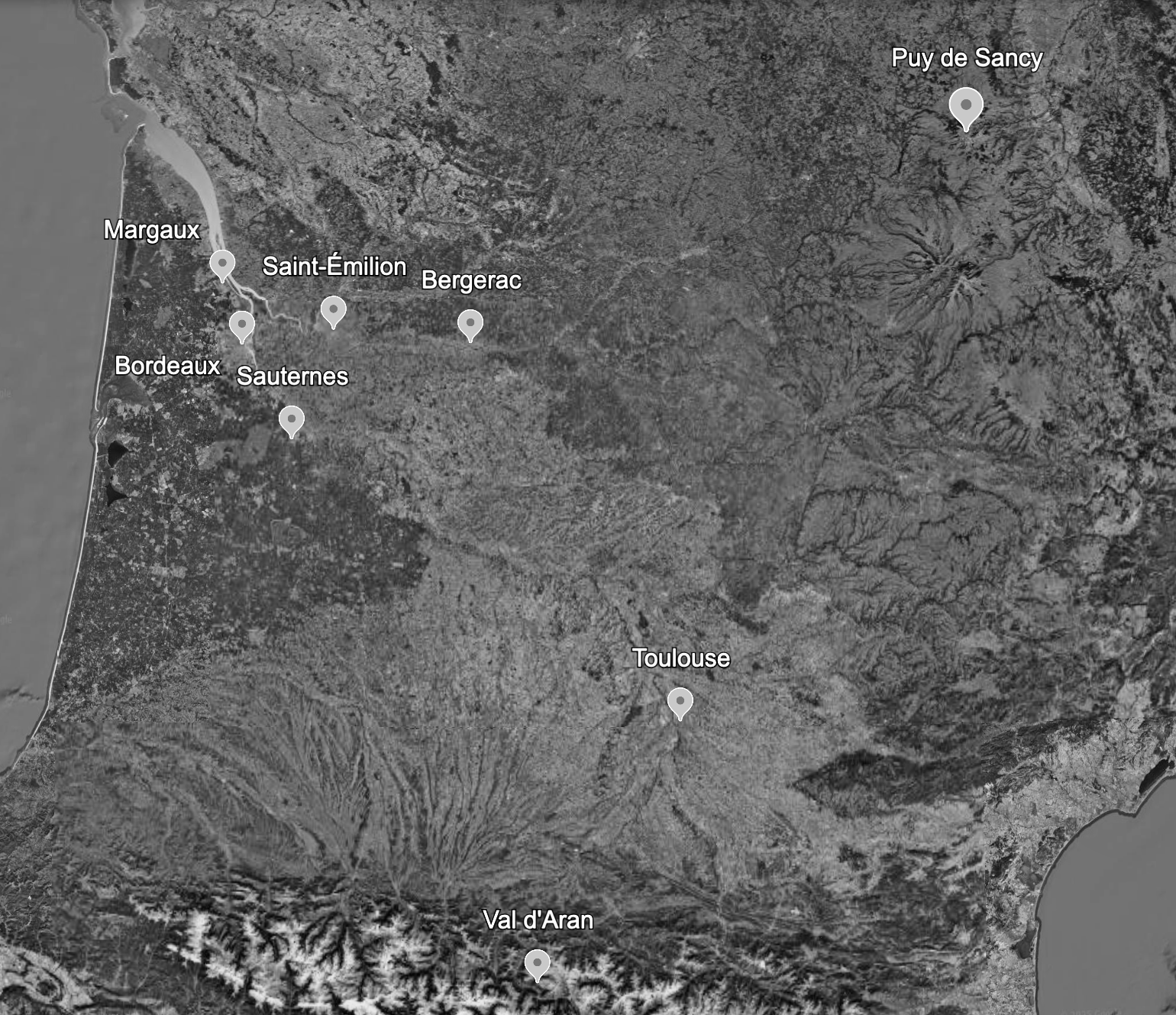
The historic importance of Bordeaux is based on many factors, not least water. The city is located just south of the Gironde estuary on the Atlantic coast. Two major rivers flow into the estuary: the Dordogne, which begins its course over 480km away in central France, and the Garonne, which starts 530km away in the Pyrenees. Both rivers begin in mountains, tumbling down towards a more leisurely journey to the Atlantic. There aren’t that many wine other regions associated with the two rivers, besides Bergerac where the vineyards are situated on either side of the Dordogne.
The significance of the rivers only becomes profound as they reach the end of their journey in Bordeaux, where, as they flow into the Gironde estuary, they are some of the most important and influential bodies of water in wine. The great villages of Bordeaux lie right next to them, the influence of the water a subtle but important factor in the vines’ growing environment.
Not only for grape-growing, though. Bordeaux’s position by the Atlantic made it historically central to international trade. The streets on the banks of the Garonne are lined with old merchants’ houses, where wine was traded and sent to northern Europe and then the Americas. Wine was transported along the rivers and then abroad through the estuary. This strategic position gave Bordeaux an advantage over neighbouring regions: the city charged duty on other wines from south-west France which needed to travel through Bordeaux to be sold overseas, whereas the wines of Bordeaux were not taxed. This was true of Cognac too, in contrast to Armagnac through which the Garonne flows, but much further inland.
Bordeaux is the largest appellation in France. In the centre is Entre-Deux-Mers, literally “between two seas,” indicating the importance of the two rivers. To the west of Entre-Deux-Mers is the Garonne, to the north the Dordogne. Entre-Deux-Mers itself is a big appellation, technically only for white wine although there is a great amount of Merlot grown there. Within Entre-Deux-Mers, the historically important though small appellations are all near one of the rivers, while the lesser wines are grown further away from water.
Médoc—often referred to as the Left Bank—is north of the city of Bordeaux. Although there are two appellations further away from water (Listrac and Moulis), the four most prestigious are all on the Gironde estuary. The most southerly village is Margaux, which is where the Garonne and Dordogne meet at the beginning of the estuary, leading to different soil types than Pauillac further north. Bordeaux is not known for its hills, but gentle, undulating slopes rise up from the water, creating a vineyard-based terroir we associate more with Burgundy. There are six terraces (only Margaux has all six), which have slightly different levels of elevation and soil types. The Médoc used to be a marsh, only drained by the Dutch at the beginning of the seventeenth century. The drained water left behind large pebbles and gravel soils, perfect for ripening grapes, creating a “gold rush” which saw plantings and the establishment of famous châteaux. Drainage remains important: there are small rivers, such as Estey and Jalles, which fall into the estuary and have been incorporated into the drainage system. Bordeaux is partially protected from the Atlantic by forests, but it still gets wet and channelling the water into the estuary is vital.
To the south of Bordeaux is the Graves appellation, the first named region within Bordeaux. The soils here are gravel, hence the name, and the appellation, which includes Pessac-Léognan, runs along the Garonne until it reaches Sauternes. Near Sauternes, there’s a tiny, but all-important river, Ciron. It’s a cold body of water which meets the much warmer Garonne; the confluence creates mist in the morning which creates rot in the grapes planted on small slopes between the rivers. When that rot is noble, it leads to some of the greatest sweet wines in the world. There’s also sweet wine on the other side of the Garonne, not as famous but also influenced by the proximity to the river.
The Dordogne, or the Right Bank, is more known for Merlot than the Cabernet Sauvignon of the Left Bank. The appellations are on slight slopes which rise up from the river with various soil types: clay, limestone, sand, and some gravel. Not surprisingly, the soils are sandier near the river. The slopes and valleys on the Right Bank were shaped by the direction of the Dordogne, which means the styles of wine in the ten appellations and by individual producers differ according to site. This can be quite frustrating in St-Emilion, where there are many soils and quality and style vary. Pomerol rises up from the Dordogne to a plateau which slowly descends into Lalande de Pomerol, a separate appellation not as strongly influenced by the river. The wines of Lalande de Pomerol are good, but are not as intense as Pomerol itself which overlooks the Dordogne.
The rivers demonstrate that Bordeaux is not one uniform concept. The essence of Bordeaux is water: the Atlantic, the Gironde, the Garonne, the Dordogne. Just look at a map and see how every appellation is connected to a body of water; the nearer to water, the higher the quality.
the combes of burgundy
The first time I ever heard the word “combe” was in a Burgundy class. I had to look it up to see what the word was in English: turns out it’s “combe” (though there are spelling variants) and the etymology of the word is English. How ironic that Burgundy, the home of terroir, a word impossible to translate into English, should use an English word that is at the heart of the concept of terroir.
The meaning of “combe” is a hollow valley. In Burgundy, these small valleys have been formed by streams that fall from the top of the escarpment in Côte de Nuits in particular. As these streams—barely noticeable when visiting Burgundy—have move downwards over millennia, they’ve pushed the land in different directions, creating the mini-valleys. This produces a kalediscope of slopes, vineyards with various aspects without which Burgundy becomes a uniform region rather than the essence of terroir. The effect of the streams help us understand that concept: at the bottom of the slopes there are alluvial, fertile soils producing relatively simple wines but also acting as drainage for the famous vineyards on the slopes themselves where the soils are limestone based.
The importance of water in Bordeaux may seem quite apparent, with the Dordogne, Garonne, and Gironde very well-known; but their importance has many subtle aspects besides dividing Bordeaux into different sub-regions. Water is much less talked about in Burgundy, but vital to understanding how the small, hollow valleys were created because Burgundy, one of the most important wine regions in the world, wouldn’t exist without those small streams.