WSET Beer Courses
Way back in the day, the WSET had beer and cider as part of their courses, as well as wine and spirits. I’ve never quite understood why beer was removed but now it’s back as its own course (though still no cider). Over the last few months, I’ve taken Levels 1 and 2 in Beer through Commonwealth Wine School (for whom I teach). Both were online, which is not my preferred means of either teaching or learning, but the school has created fantastic content to make the online experience as close to an in-person class. Through studying the course I’ve learnt a lot about how beer is made, consolidated knowledge of styles of beer I don’t usually drink, and learnt some weird words like strig (a stalk) and bract (a leaf).
why was beer removed and why is it back?
I’m guessing that in the 1990s beer had become so uniform it wasn’t worth studying (that’s a guess, not a fact). Maybe that’s me growing up in the 1990s in the UK, when mainstream lager had become dominant. There were alternatives to lager, but bitters were also dominated by big brands: Boddington’s (I’m from Lancashire, so that was always my tipple), Tetley’s, John Smith’s, the heinous Sam Smith’s, Young’s, Fuller’s, Bass. There were also Irish stouts, most obviously Guinness but also Murphy’s and to a much lesser extent Beamish. (Fun myth: Samuel Beckett regularly walked the Irish countryside to find pubs that sold Beamish because it was the hardest to find.)
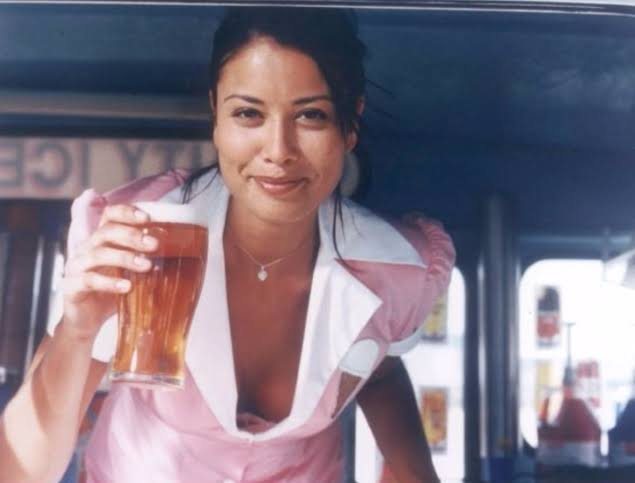
Since the 1990s, the beer scene has changed radically. Some of those brands, like Guinness, have consolidated their position even further; others have been bought and broken down. Boddington’s, which ran iconic advertising campaigns in the 1980s and 1990s (see the image above), is a shadow of itself since it was bought by InBev Anheuser-Busch, a global conglomerate which also owns Budweiser. In contrast, the craft beer scene emerged and changed not just perceptions of beer but also how it was made.
When I first drank beer, I had no idea of the names of hops. Now, beer enthusiasts can list the names of hops from Britain, Germany, Czechia, New Zealand, Australia, and the USA. Most of the time I’ve visited France, Italy, or Spain, the beer, in contrast to the wine, is terrible, mainstream lager. But now in the major cities there are craft breweries making diverse styles of beer. Beer-drinking culture is a very different world from the 1990s, even if modern beers are based on tradition as well as innovation. Which is why it’s so welcome that the WSET have re-introduced beer courses to help us understand all the styles and trends in the beer industry.
what did I learn?
Beer is as much about place as wine, but in a different way. Hops can only be grown at 35-55° latitude, not too dissimilar to wine, but slightly warmer conditions. Hops are strongly associated with the region they originally come from, but can be used anywhere in the world. For example, hops developed in the USA, particularly Washington State, can be used to make beer in the UK; hops developed in New Zealand are used in the US. It makes beer a very international drink.
But the origins of beer are very much about place. Kölsch comes from Cologne; Munich Helles from Munich; Pilsner from Plesň in Czechia; porter originates in London, stout in Dublin; New England and West Coast IPAs are, well, from New England and the West Coast of the US.
Yeasts also determine the style, which perhaps deflects how important place is—but then winemakers use cultured yeasts too. There’s lager yeast, which takes months to complete full fermentation; Weiße yeast; ale yeast (both British and American); Abbey Ale yeast; active yeast that is left in the bottle. Brewers, particularly in Belgium, allow spontaneous fermentation which may lead to the development of Brett (a strain of yeast): sour aromas disliked in wine but encouraged in certain styles of beer. These different types of yeast affect flavour, which is why there are so many different styles of beer.
Likewise with the malt used for fermentation. The grains used for beer—usually barley, just like whiskey, but also occasionally wheat and rye—cannot be naturally fermented as they contain starch rather than soluble sugar. The grains are milled, mashed, and kilned in order to convert the starch into soluble sugar, again just like whiskey (the base of whiskey is unhopped beer). There are base malts which are kilned at low temperatures, minimising aromas, and there are speciality malts which are used in small amounts, kilned at higher temperatures, adding roasted, smoked aromas. This is one of the reasons why there is such a big difference between a lager and a porter, for instance.
different types of beer
There are so many different types of beer. Before this course, I would have just said there’s lager and there’s ale, but I’ve learnt that it’s much more than that. There are malt-driven lagers and malt-driven ales; there are hop-driven lagers and hop-driven ales; there’s strong ale; and there are the Belgian styles which are replicated by many craft breweries across the world. There are hopped lagers with a more bitter taste, smoked lagers like Rauchbier Märzen, dark lagers like Dunkles Bock.
The dominant style of lager which is straw-coloured, low in alcohol, and flavourless originates in the US, the biggest brand being Budweiser, a name of Czech/German origin. It’s named after a Czech town called Budvar, where there is also an important brand called Budvar which has Budweiser on the label—because Budweiser means from Budvar. The two companies dispute who has the right to the name, but the Czech name is intrinsically attached to the name of the place. And it’s not made with rice.
I associate ale with Britain and Ireland, though it’s also made all over the world in many different styles. In fact, some lagers can be classed as ales: I remember visiting Cologne and in each bar there was a server carrying a tray of Kölsch. You didn’t have to order or even move: just a raise of the eyebrow, and the glass (called Stange) was on the table. Kölsch is a hopped lager made with ale yeast which gives it a bitter finish.
Malt-driven ales are very different from the hoppy beers of the US, Australia, and New Zealand—it’s quite noticeable when I return to the UK from California how malty the beers taste. The choice of malts changes the colour: a blonde ale, a brown ale, an Irish red ale, a porter, a stout, all with distinctively different appearances and flavours due to the malt and how it’s kilned.
belgian-style beers
Belgium is of course hugely important for the culture of beer. It’s where spontaneous fermentation is encouraged and the Brett yeast strain allowed to develop. In Belgium, these are called lambic beers which are made by monks. Well, kind of. Trappist beers are actually made by monks, which is why there isn’t that much made these days (though there is a Trappist monastery in the US), while Abbey Ale beers are commissioned by monks (Leffe being the most famous example). Similar beers are made around the world, usually called sours. I just tried a beer aged in used Merlot casks from Russian River Brewing, who popularised the style in California. Such beers do taste weird (or “funky”) because of the Brett, but they are distinctive and unique.
barley wine
Barley wine is slightly nuts: extremely high in alcohol, stronger than many wines. It’s usually bottled in 750ml glasses, and served in snifters (small brandy glasses). There’s a reason for that: you only need to snift it and you’re done. In the UK, it’s mainly made in the south-west of England, where they like they like their drinks hard (Devon and Cornwall are famous for cider and infamous for Buckfast). Barley wine is also made in the US; Sierra Nevada, one of the first craft producers, have their own version which comes in at 12.5% ABV. Not to be outdone, the Scottish have Scotch Ale, another high alcohol beer. These beers really do taste of alcohol, even more so than wine despite similar levels.
This is just an overview of the vast world of beer. Place, yeast, hops, tradition, beer-making choices, ageing (or not), all influence the final style of a beer. And, as with all beverages, who drinks it.