Amarone
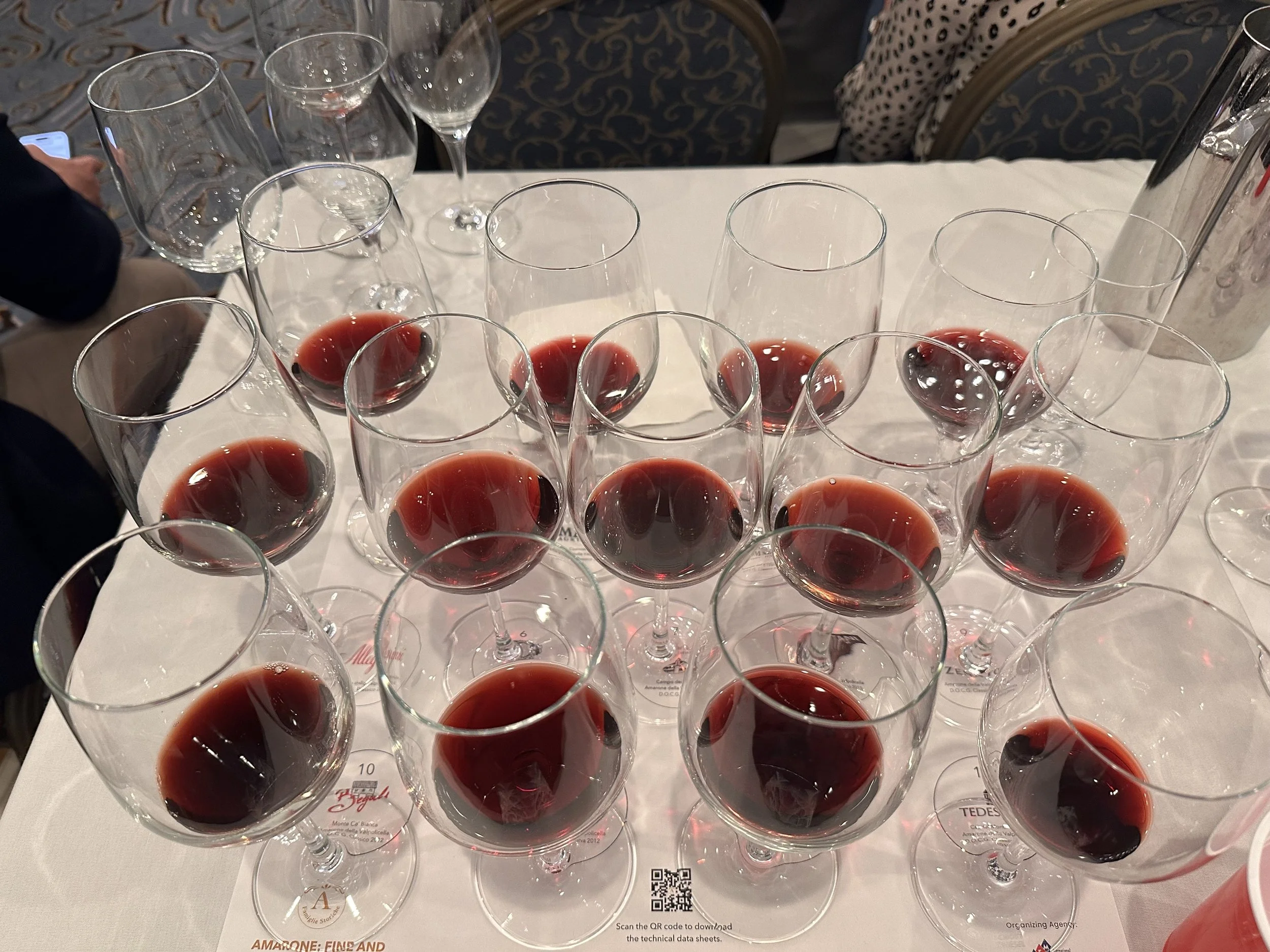
Tasting 13 Amarone wines is hard work; there’s a lot of alcohol, a lot of tannin, and a bit of sugar. And if I weren’t in the wine industry—therefore able to attend an event for free—it would involve a lot of money as Amarone retails for $70+. But there I was, at the Fairmont, a luxury hotel in San Francisco, with nearly 80 other people at a masterclass with a representative from each producer. I went into the room wondering who actually drinks Amarone, left figuring more people than I thought, and also asking myself how is the region able to afford to send all these producers to the US? Such are the contradictions and paradoxes of Amarone.
what is amarone?
Amarone is made in the Valpolicella region just east of Lake Garda. Valpolicella is one of those Italian regions that over-expanded in the 1960s when DOCs were created; even now, a lot of Valpolicella is dilute and thin, coming from the fertile plains. Amarone maintained quality wine from the region, with grapes grown on hillside slopes for more robust wines which have influenced the nature of better Valpolicella.
Amarone is a very specific style. Back in Roman times, wines were usually sweet—Recioto is a sweet red wine still made in the region. Amarone was considered a Recioto “gone wrong,” because rather than being sweet it was bitter and tannic: Amarone means very bitter. Until fermentation was fully understood, a lot of Italian red wine was sweet, for instance Barolo and Barbaresco. But as understanding of fermentation increased, the wines became drier: the first commercial Amarone was released in 1953. Amarone is a combination of Italian history and modernity.
how is amarone made?
Amarone comes from vines planted on hillside slopes, and is generally a blend. The grapes are picked fully ripe with lots of sugar—though with climate change, picking is getting earlier. They are then dried for three months to concentrate the sugars, which leads to the high levels of alcohol. One interesting observation during the tasting was that growing conditions are fairly consistent; it’s the drying conditions that can vary from year to year. This affects the length of time the grapes are dried, and the final character of the wine. The wines are then aged in oak barrels for at least three years, longer for a Riserva. The size and age of the oak barrels means that style changes from producer to producer.
what does amarone taste like?
It depends on the producer, but the wines are always going to be high in alcohol, 15%+. There’s been a trend to reduce levels of alcohol, but it’s still not unusual to find wines with more than 16%. The wines are likely to have residual sugar of around 5-6g/l (varies from producer to producer), necessary to balance the high alcohol. All of this makes Amarone a very distinctive wine: off-dry, high tannin, high alcohol, full of dried fruit aromas.
grape varieties
corvina
Considered the finest of Valpolicella’s grape varieties, Corvina can still be very vigorous on the valley floor—an example of how the best Italian wines in northern and central Italy come from vines grown on hillside slopes. Although there are single-varietal examples, Corvina is usually the dominant part of a blend for any quality Valpolicella or Amarone wine, providing a firm tannic structure, fresh acidity, and sour cherry aromas. In other words, very Italian.
corvinone
Despite its name, Corvinone is not directly related to Corvina. It usually only forms a small part of a blend for both Amarone and Recioto, adding a tannic, fruity texture. In wet years, it’s prone to fungal disease so it forms a greater part of a blend in drier years.
rondinella
This is the grape variety Valpolicella producers love because in the words of one winemaker, “It pays the bills.” Which is to say, yields are high. For this reason, DOCG rules limit the amount of Rondinella that can be in a blend, but, aside from yields, it also adds fruity cherry aromas.
molinara
Plays a minor part in blends due to its pale colour and being subject to oxidation. Older vines produce more substantial wines.
oseleta
In any tasting of Italian wines, there’s always a variety you’ve never heard of. Oseleta is a local variety revived since the 1970s when it was almost extinct: there’s still only about 20ha planted. When used in a blend it provides tannins and leather aromas with age.
croatina
A grape variety mostly associated, if at all, with Piemonte (it’s also called Bonarda, but is different from the Bonarda of Argentina). I had no idea Croatina was planted in Valpolicella, but there’s also Sangiovese and Barbera to be found. Croatina produces fruity, colourful, spicy wines in a blend.
when and where to drink amarone
A wine as distinctive as Amarone may make it difficult to come up with an obvious food pairing. But this is Italy, so there are lots of options: mushroom risotto, wild boar, steak, lamb, hard cheese. I can’t imagine drinking Amarone on its own, but these dishes complement the strong structural elements of the wines.
standout wines
Tasting 13 wines showed the diversity of Amarone, though they were all characterised by high alcohol, high tannin, oak, and the clear capacity to age.
My favourite wine by far was the 2012 Riserva by Musella (c.$75). This was a classic Amarone, showing how gracefully the wines can age. A very sophisticated wine, pale in appearance, very pretty, floral, herbal, and spicy. Alcohol is 16%, sugar 7.3g/l, the two completely in tandem.
Another famous producer is Tomassi. We tried the 2021 vintage (c.$55), an example of a much younger Amarone. This showed how Amarone producers have worked on making the wines more approachable when young, even though they’re still ageworthy. Alcohol is “only” 15%: this is a fun wine to drink.
The tasting began with Guerriri Rizzardi “Calcarole” (c.$80) also from 2021. It was a great place to start: off-dry (5.1g/l) and high in alcohol (16.5%). So far, so Amarone. But it also had Sangiovese and Barbera in the blend, demonstrating that Amarone is not to be taken for granted—there’s always a surprise, even in the first wine you taste. And it was delicious: ripe, spicy, oaky, and very smooth.
I’m still not sure who drinks Amarone. The wines are expensive and high in alcohol, often off-dry, and very tannic. But it’s clear that the wines age for many years, and are ideal in an Italian restaurant or a steakhouse. The wines are substantial and intense, and of uniformly high quality. I’m not sure how they fit into current trends for low alcohol wines, but food pairings are central to their identity. Next time you’re in a high-end restaurant, get a bottle of Amarone and see how it matches the different dishes you eat.