Oregon 3.0
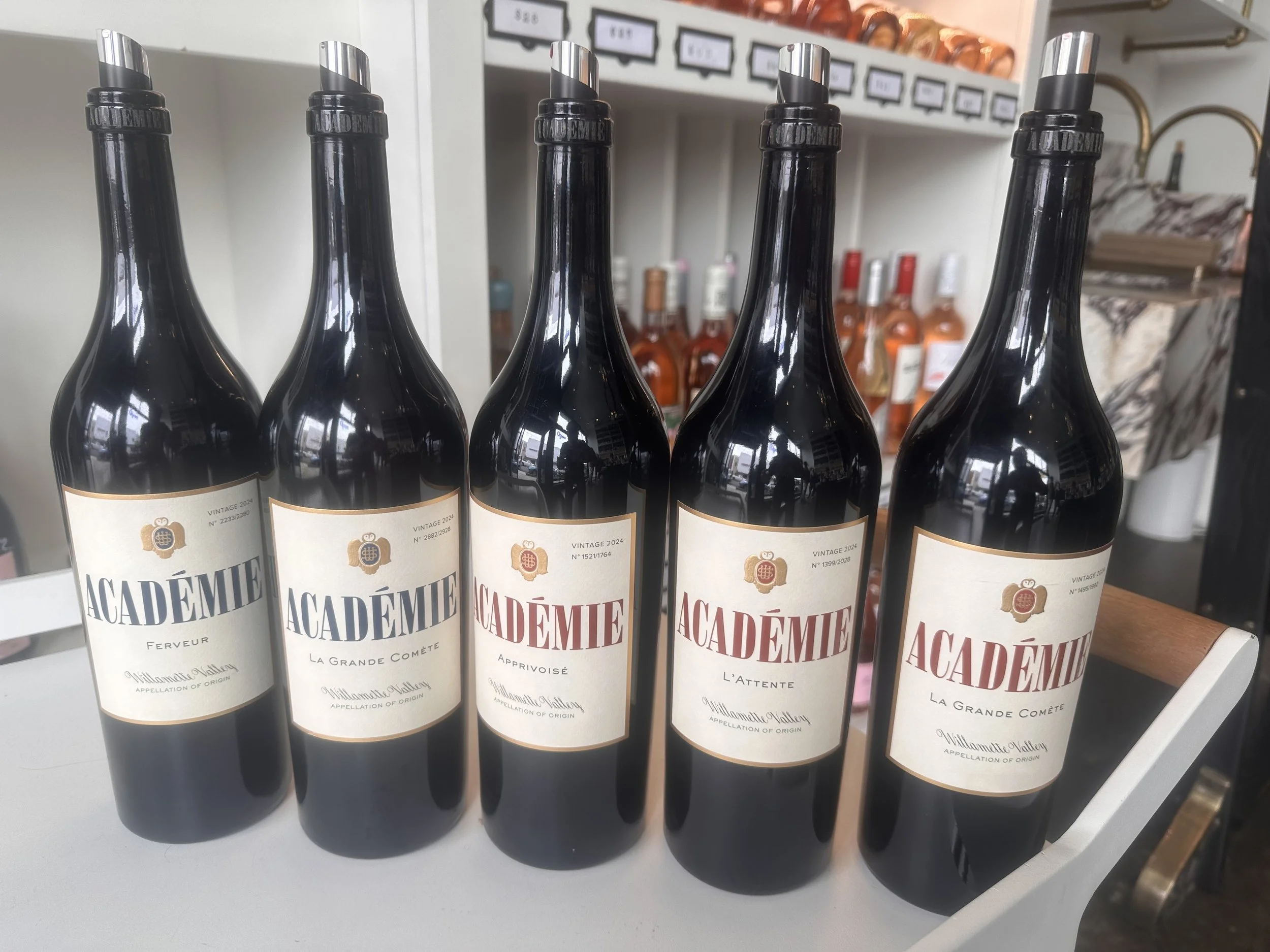
I just attended a tasting of (a kind of) brand new Oregon producer. The winery is called Académie, a name inspired not just by educating the consumer about the wines of Willamette Valley, but also educating themselves. It’s a project founded by winemaker Thomas Savre and Joshua Wludyka—I was lucky enough to be the first to taste their inaugural vintage.
The French connection is interesting. Thomas Savre is originally from Lorraine in France (where making wine is very difficult) and worked in Burgundy, including a year at Domaine Romanée de la Conti (aka DRC). I asked him why he moved to Burgundy. He gave two reasons: his wife (I can speak to that, that’s how I ended up in California) and he was told just how exciting the wines of Oregon are with the potential to develop even further.
This isn’t the first time that a Burgundy producer has been enticed by Oregon. In 1979, Robert Drouhin tasted the 1975 Eyrie Pinot Noir, and was persuaded to establish a winery, which he did so in 1984. In turn, he persuaded his daughter Véronique to become winemaker, her first job after graduating. Now, Domaine Drouhin Oregon is one of the state’s finest producers.
There’s also another label whose wines Thomas makes: Ostia Tempore, which was founded by Bertrand de Villaine of DRC. It was launched in 2016, and was made solely for the French market—this is the first time the wines are available in the US. It may seem bizarre that an Oregon winery would only sell their wines in France: who buys Oregon wine in France? (I never have!) But it’s part of that French connection.
Oregon now has an evolved history; it’s no longer a new winemaking state. Joshua outlined this quite neatly. There’s Oregon 1.0, when producers like David Lett of Eyrie started planting vines in the 1960s even though they were told it would be impossible to make wine in such a cool place. However, Lett had done his research and believed it possible, planting Pinot Noir, Pinot Gris, and Chardonnay. It turned out he was right.
Oregon 2.0 came in the 1990s onwards, by which time people—producers, trade, and consumers—had already realised that there were some fantastic wines being made in Oregon. Investment and new wineries began in the 1980s, and accelerated from then on. The quality reputation of Oregon’s wines was assured.
Now we’re into Oregon 3.0. When talking about Oregon, we’re mainly talking about Willamette Valley (there are other AVAs outside the long, hilly valley). We then talk about the many AVAs within Willamette Valley (and there are arguably too many). But we don’t talk about vineyards. That’s the mission of Académie, to explore the specific terroirs of Willamette Valley and to think of the vineyards as Crus, just like Burgundy. This is still a new initiative for them as they’re still learning which vineyards they love: hence the name Académie.
I was once told that Willamette Valley is the closest region in style to Burgundy, which would explain the French interest. I’m not sure that’s true. Willamette Valley has a dry, mild summer climate that’s warmer and more consistent than Burgundy; however, it rains in September which makes harvesting timing tricky. In general, the wines are riper than Burgundy, although one of Académie’s Chardonnays in particular (“Ferveur”) could be mistaken for Burgundy. But what’s the point of simply replicating Burgundy?: make it taste like Oregon.
Which is what Académic are trying to achieve. The wines are expensive ($60-$160), but they’re quite delicious. The Chardonnays are lean, elegant, and clearly ageworthy; the Pinot Noirs have a smoky, spicy, herbal character. Even though the wines are very young—all the wines I tasted were from 2024—they’re very drinkable right now, which reflects what both Thomas and Joshua said. They want the wines to be fun, and they want to have fun. This is a winery to follow, as Oregon continues to evolve its understanding of itself as it moves into a new era.