Italian Wine Ambassador
I teach WSET courses for Commonwealth Wine School in San Francisco (they’re also based in Boston); they very kindly gave me the opportunity to travel to New York to try and become an Italian Wine Ambassador, a role promoting Italian wine. I signed up without hesitation. I regularly taste Italian wine and I’ve visited the country many times: my sister lived in Florence for nearly ten years, and we travelled all over Italy whenever I flew over to see her. Alongside France, Italy is the biggest wine-producing country in the world and this was a chance to learn even more about the wines than I already knew.
But this being Italy, the course was intense and chaotic: it certainly reflected the country’s culture. That observation may buy into stereotypes of Italy, and it’s important to challenge all stereotypes. But the required textbook, Italian Wine Unplugged 2.0, written by Attilio Scienza, was the most confusing and difficult to follow wine book I’ve ever read. There were also 46 videos to watch, and to be honest I just gave up and flew to New York in the hope that my previous knowledge of Italian wine would be enough to get me through the exam.
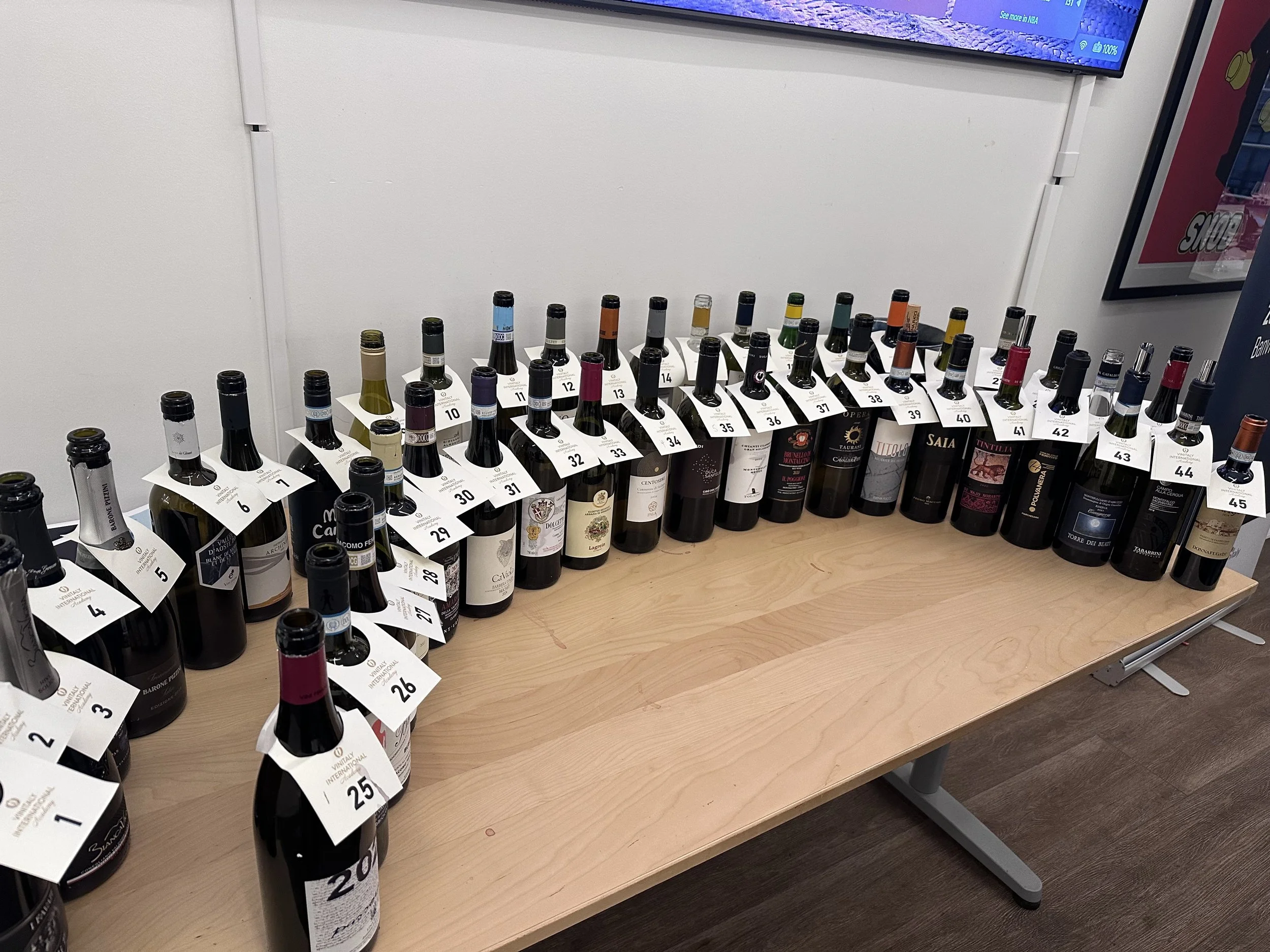
The first day was all tasting; that is, tasting 45 Italian wines for several hours. People who are not in the wine industry think tasting wine is fun and not hard work: when the 44th wine is Sagrantino, perhaps the most tannic of all Italian varieties, I can attest that it is hard work. Tasting all these wines demonstrated the diversity—and also the difficulty—of Italy: Piemonte, Valle d’Aosta, Alto Adige, Trentino, Friuli, Liguria, Veneto, Emilia-Romagna, Lazio, Toscana, Umbria, Marche, Abruzzo, Molise, Campania, Calabria, Basilicata, Puglia, Sicilia, Sardegna; wines that are dry, wines that are sweet, wines that are sparkling. Tasting the 45 wines was just a dip in the ocean.
This, of course, is why Italian wine is so enthralling. Italy, as a country, was only unified in 1861, having previously been a series of duchies and kingdoms. That’s why there are so many distinct dialects and different names for the huge range of grape varieties. It also makes it a difficult country to understand. In the 1990 World Cup, Argentina played Italy in the semi-final in Napoli. Diego Maradona had guided Napoli to the their first ever Siere A titles; he was the greatest player in the world; he assumed that the fiercely independent Napolese would support him over Italy. He was wrong and visibly shocked when he was booed by the Italian fans. That’s Italy: you may think you understand it, but you never will.
But back to the course. The second day was the exam: two blind wines; two short written answers; and 100 (!) multiple choice questions. The first wine was a white, and no one (there were about 50 of us) identified it correctly. Understandably so: the variety was Alabana, which I had only learnt about three days before the exam. It’s from Emilia-Romanga; historically made sweet but dry styles are more common now; it’s considered a tannic white grape; there are two DOCs and one DOCG. I really liked the wine: it had a lees, tannic quality, but how anyone would be expected to identity it, I don’t know.
The second wine, red, was more classic but I still got it wrong! I said Brunello, but it was Barbaresco. This is a common problem for me, confusing Nebbiolo and Sangiovese, but I was convinced it was Brunello because the tannins felt softer than Nebbiolo: but that’s a good description of Barbaresco too.
The short written answers were two questions, and we were only given thirty minutes to answer them: I would have liked more time to provide more detail. One question was on how to organise an event to promote an Italian wine region. I chose Collio in Friuli, suggesting an Italian restaurant in San Francisco with specific food pairings to demonstrate the character of the region. The other question was to pick examples of an Alpine climate (I chose Alto Adige, one of my favourite regions), of a Mediterranean climate (I chose Puglia), and of a continental climate (I chose Montalcino—even if I can’t identify the wines, I love them).
So I was feeling fairly confident and calm, until the multiple choice questions came along. The questions were so obscure, asking about pre-Roman plantings, post-Roman revival, grape varieties and DOCs I’d never heard of. As a wine educator, I firmly believe in making wine as simple as possible rather than intimidatingly complex: these questions were very much in the latter category.
I assumed I’d failed, which was very annoying as I pride myself on my wine knowledge and also because I’d flown all the way to New York. The “pinning” ceremony was later that day; I was reluctant to go, because I thought what was the point? The successful candidates’ names were announced one by one and along with everyone else I applauded each of them, proud of their achievements, while wondering if, having failed, I would want to do this course again. And then my name was called out! I walked up to receive my pin; Stevie Kim, who runs VinItaly and is hilarious, said “you don’t look very excited”; I wanted to say I’m from the north of England, we never look excited, but I just replied, “I’m very surprised.” Which was true.
I certainly wouldn’t say I’m an expert on Italian wine: it’s almost impossible. But I guess I know a fair amount and I’m very proud to have got through this course. And I’ll always promote Italian wine whenever possible. I celebrated by having a wild boar ragú—with a French wine ;-)