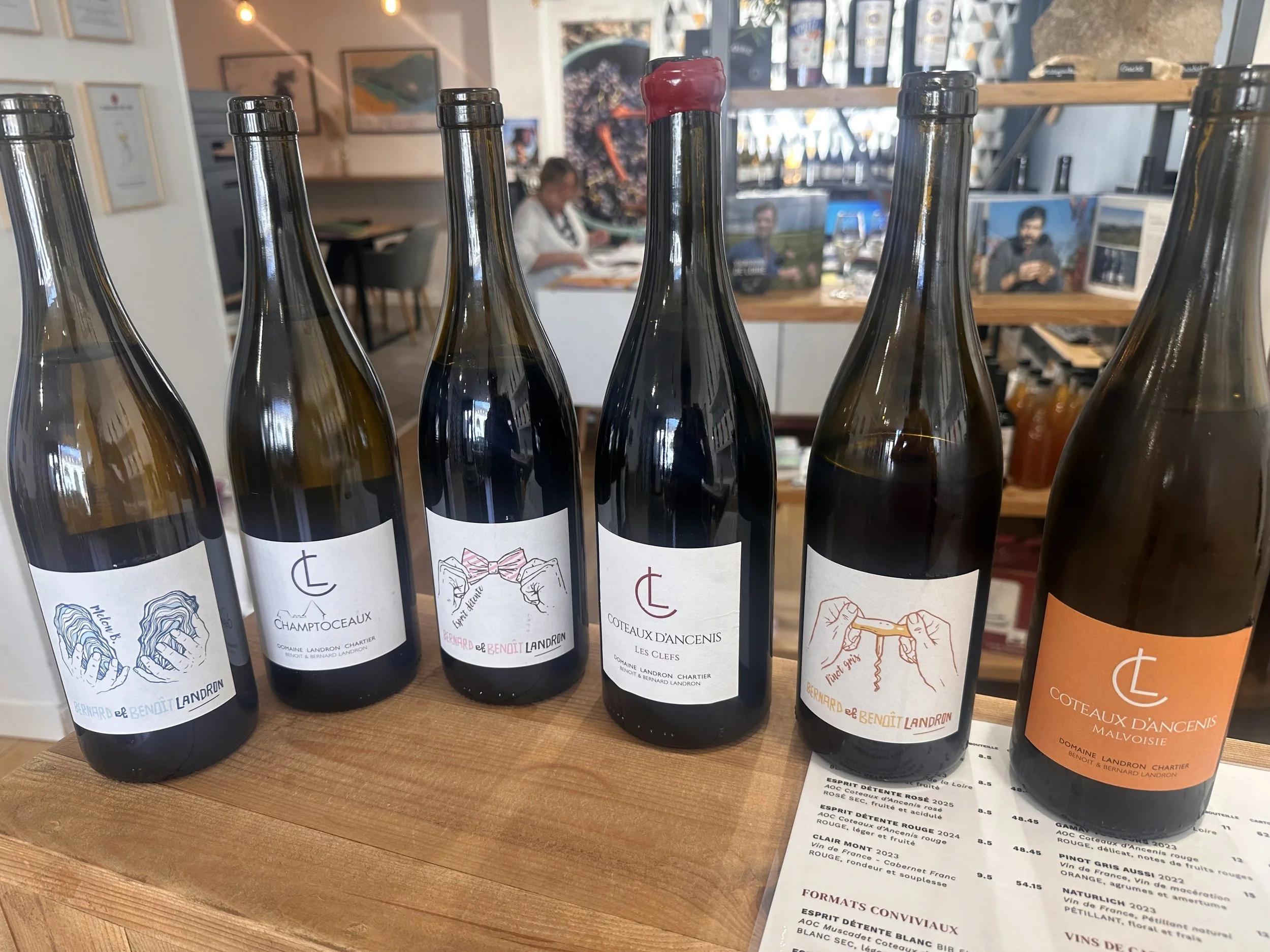
Whenever I visit the Loire Valley, I think about the importance of appellations because there are so many—it’s impossible for the average consumer to understand all of them. Even such a famous name as Muscadet is complicated, as there are four different appellations—Muscadet, Muscadet Sèvre-et-Maine, Muscadet Côtes de Grandlieu, and Muscadet Coteaux de la Loire. Add in Gros Plant de Nantais (made from the Folle Blanche variety) and Coteaux d’Ancenis (from Gamay), and you’ve got six appellations surrounding the city of Nantes (which I’ve just been visiting). Oh, and then south of Nantes is Fiefs Vendéens.
But producers also break away from these appellations, making wines under the IGP and Vin de France designations, both of which are increasingly important in the Loire Valley and across France.
Indication Géographique Protogée (IGP; PGI in English) is a regional designation which allows greater flexibility for producers in yields and permitted varieties. IGP doesn’t quite allows producers to do whatever they like, but it’s far less restrictive than an appellation.
The concept originated in Italy after the disastrous decision to make the Chianti DOC (the Italian equivalent of an appellation) seven times bigger than its historical centre. Quality producers declassified the wines, using Bordeaux varieties, and distancing themselves completely from Chianti. The wines, informally called SuperTuscans, were expensive and extremely successful and eventually caused the rewriting of Chianti’s regulations. In the early 1990s, the IGT designation was created to allow these non-traditional wines to be incorporated into a Tuscan identity.
This coincided with the rise of non-European wines where rules are much less forbidding. In Australia, regional blending is common. When the country was forced by the EU to create geographical indications in the 1990s, the South-East Australia GI was made to cover just about every grape-growing area across Australia, from Tasmania to Queensland (apart from distant Western Australia). This gave producers so much flexibility; even Australia’s most famous wine, Penfolds Grange, comes from five very scattered vineyards across South Australia.
That flexibility provided a serious threat to the international dominance of French wine, which is where IGP and Vin de France designations become important. The latter was created as a direct response to Australia. Vin de France has two simple rules: the grapes must come from France and the wine must be made in France. And that’s pretty much it.
Vin de France allows big producers to make high-volume wines which can commercially compete with Australia and California. But it also allows small producers to do whatever they like. Want to make Gamay in a region that doesn’t permit Gamay? Then bottle it as Vin de France.
IGP is a bit more restrictive as there are regional rules, but it still allows flexibility. In Languedoc, an anarchic region, the IGP regulations permit 55 varieties which is why everything from Viognier to Merlot is found. There are so many appellations in Languedoc with restrictive blending rules that IGP becomes a very useful liberty tool. However, that doesn’t guarantee quality.
Another IGP where quality isn’t guaranteed is nearby Côtes de Gascogne which overlaps with Armagnac. The two main varieties are Ugni Blanc and Colombard; neutral and high acid, they’re perfect for brandy but boring for wine. The result is inexpensive white wine you’ll find on a plane (unless you’re flying business).
This is why I find Vin de France the more exciting designation which allows full freedom for producers. Quite literally: “Liberty” by Domaine de la Barroche is made from grapes grown just outside Châteauneuf-du-Pape that don’t qualify for the appellation but the wine tastes just like the best Châteauneuf-du-Pape. Solution: label it Vin de France.
There are many producers in the Loire who do something similar, using Vin de France to make wines outside regular appellation rules. Instead of Grolleau being used for uninspiring rosé, there’s fun, fresh, light-bodied red wine; there’s Côt, known elsewhere as Malbec; there’s Pinot Gris, known locally as Malvoisie; there’s Cabernet Franc grown where it shouldn’t be; there’s even Cabernet Sauvignon, though not as we usually know it. These wines are reflective of local growing history and wines, but aren’t corralled by appellation rules.
Vin de France, and the experimentation it allows, makes travelling around France and tasting local wines a more absorbing and complete experience of understanding the country’s viticultural past, present, and future. That doesn’t make appellations bad, just that there is more to French wine than just the famous regional names.