
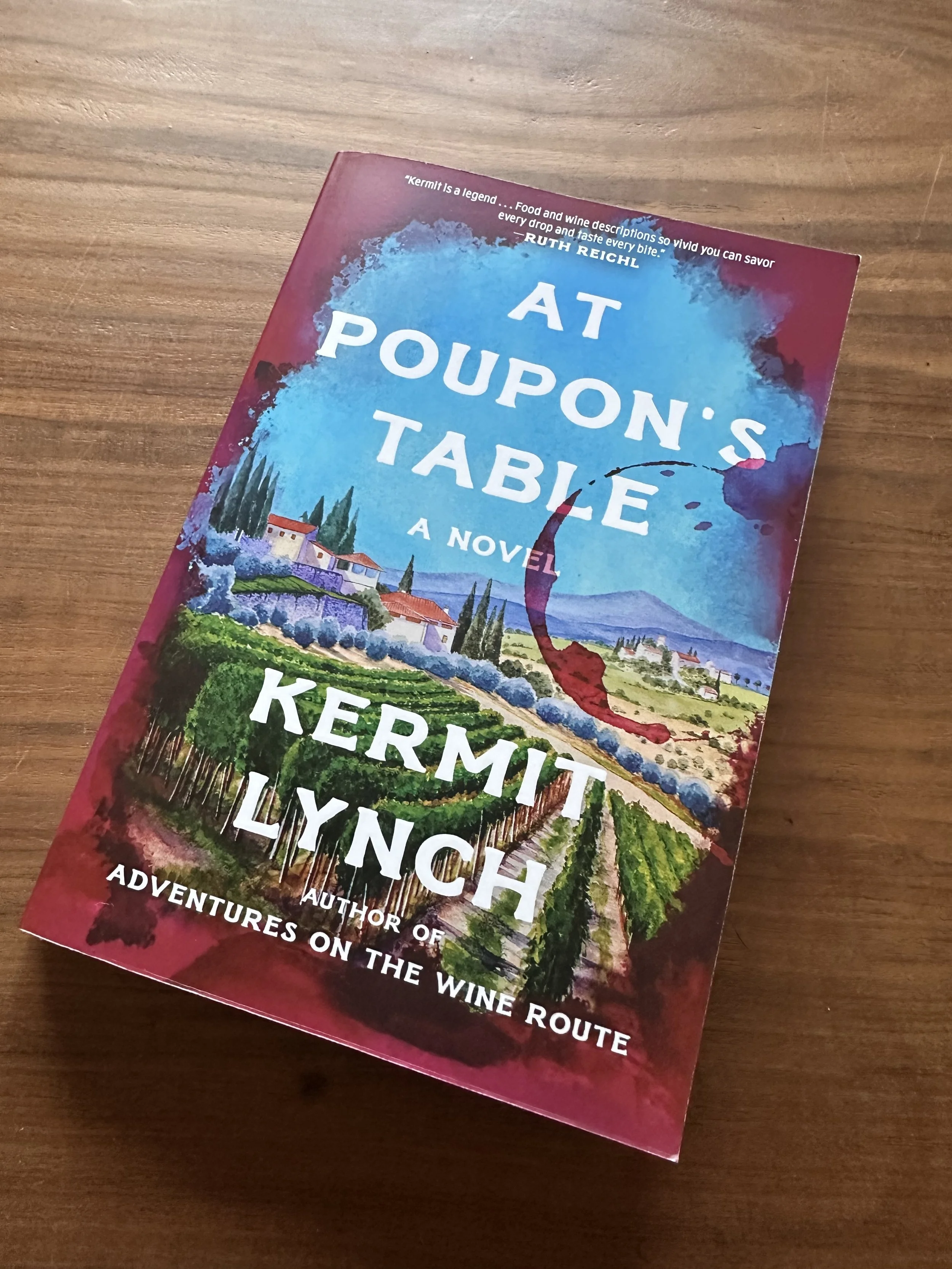
Kermit Lynch - At Poupon’s Table
When I heard that Kermit Lynch had published his first novel, I immediately messaged my sales rep asking for a copy. Kermit—we’re not actually on first name terms but that’s what everyone calls him—is one of the most legendary figures in the US wine industry and here he was, at the ripe age of 84, venturing into fiction.
To the US wine drinker, Kermit Lynch needs little introduction. Back in the 1970s, he was the first to import French wines made by small, often family, producers into the States, especially from unheralded regions, changing the drinking habits of US consumers and the attitudes of French winemakers. All of this is detailed in Kermit’s memoir, Adventures on the Wine Route (1988); now here’s a fictionalised account of his lifelong dealings with quirky, passionate, unpredictable French winemakers.
I started the book more out of curiousity, something someone in the wine industry should read. After all, the front and back covers aren’t promising: an off-burgundy background with a stereotypical sketch of Provence, the book described as a combination of Peter Mayle’s A Year In Provence and Sideways, with a recommendation from MFK Fisher who died in 1992 (it took me a moment to realise her quote was praising Adventures on the Wine Route rather than the current publication). All of which promises nothing cutting edge.
Nor does the main character, as amusing and appealing as he is, throw up any surprises: he’s called Kendrick, is an admired US wine importer, has a house in Provence with an extensive wine cellar, loves the rosés of Bandol, adores the wines of Corsica, and has a penchant for beautiful French women who happen to have a penchant for him. (Essentially the life we all dream of.)
So far, so Kermit. Yet, although the book has no discernible plot, it’s a wonderful read, charming, witty, infused not only with a love of wine but of France, its food, its villages, its mountains, and its people.
Each character is irascible in their own way: the bullish but vulnerable Poupon himself, the Corsican winemaker with mafia connections, the Provence producer whose wife wears perfume so strong it can be used as evidence in a crime case, the outsider neighbour whose mobile phone antennae are both an eyesore and a threat to children (that last bit is more or less the plot).
More than anything, At Poupon’s Table is a paean to food and drink. Poupon is in love with two beautiful women, one of whom is a mysterious Serbian called Babette. Her name is an acknowledged nod to the Danish cinematic masterpiece, Babette’s Feast, in which three elderly sisters who live on a remote, puritan island share their first and last luxurious meal. The beauty of that film is its tender reflection on life, love, loss, age, and death through the joyous lens of wine and food. At Poupon’s Table is a more light-hearted take, but nevertheless the same themes pervade the book: what is life without food which the cook—however professional or amateur they are—has prepared with such a personal investment? The dish I put in front of you: this is me.
The impassioned descriptions of the many, many dishes Kendrick and his winemakers discover, enjoy, and argue over are an irresistible celebration of life, not just of Provençal culture. Each meal is endless, lovingly, painstakingly prepared, always made from local, seasonal ingredients. There are sly digs at US fast food culture which our protagonist—is he Kendrick or Kermit? it’s hard to tell—accepts but also deflects, for example by making an exquisite burger. And, after all, he is one of the world’s leading wine experts so any snide remark on US ignorance about wine is quickly shrugged off.
The structure of the book isn’t driven so much by plot as by the copious meals and an extraordinary amount of wine. There is probably more rosé drunk in the book than any other written before, enjoyed and assessed from noon onwards. (When tasting professionally, the importance of spitting is stressed, otherwise wine is to be drunk no matter the time of day as long as it’s with food or, at the very least, while contemplating the next meal.) There are detailed discussions on the whites and reds of Bandol and neighbouring appellations such as Cassis; the wines of Corsica are taken more seriously than any other writer could; a Grand Cru Burgundy receives a religious eulogy; the ignorance of French winemakers towards other regions in the country is lovingly lampooned; a brief foray across the Alps into Piemonte takes us to Barolo, Barbaresco, Arneis, and the decadence of white truffle; a comic, unresolved undercurrent involves the difficulty in dealing with Alsace producers. Needless to say, these are all regions imported into the US by Kermit; no other European wines get a mention.
But that’s not really the point, because this is an evocation of a style of French life worth fighting for in the face of modernity. It flirts with nostalgia, a feeling that French life isn’t as good as it once was.* Tourist resorts and their ugly buildings are bad, autoroutes and their tolls are bad (which makes one wonder if Kermit ever drives anywhere in the States), and some of the digs at modern life seem like raging against the dying of the light. But that nostalgia is conveyed with a fine wit. At a local restaurant, the chef presents a menu he’s created to mimic the frozen food prevalent across France (and this is a fact, so much French food is now simply second-hand and pre-prepared). And, of course, the frozen food menu the chef has created is magnificent because it’s based on fresh ingredients that can be put aside for a few days until ready to be cooked. Nostalgia can be a sentiment that fuels the future.
At Poupon’s Table ends in slightly farcical fantasy, but not after having transported the reader to the infuriating but irresistible joys of Provence and Corsica. It’s a novel that demands a glass of wine while you read it and makes you question every life decision you’ve made that hasn’t involved garlic.
*for reasons the novel never explains, it’s set in 2006
