
German Wine Consultant
I first visited Germany when I was nearly nine years old, in 1985. It was to Hamburg—I’ve never been back though I would love to. After all, it’s the city in which the Beatles found their feet. After that, I went to Germany several times as a teenager, to the Black Forest, to Bavaria, to the Ruhr Valley: extreme beauty to industry, just like the north of England. Although I’ve been back to Germany several times since, I’ve never had a truly immersive experience in German wine: the regions, the people, the wines themselves.
Therefore, I was excited to visit Germany once more, on a course for WSET educators. There were twenty of us, from China, South Korea, Japan, India, Australia, France, Hungary, the UK, Sweden, Brazil, the US, and Canada. What a joy to meet so many people from around the world, some of whom I shared mutual acquaintances with: this is the interconnected world of wine.
However, the course was a little all over the place. There’s a stereotype of German culture, that’s it’s organised, efficient, based on a pragmatic interpretation of life. I learnt a long time ago that it’s not true. Germany is a country that’s impossible to comprehend fully, with so many competing identities. And that was reflected in the course: the bad boys at the back of the classroom (yes, I was one of them) kept shooting glances at each other: what is going on?
But I still learnt plenty about where German wine is at right now.
de-alcoholised wine
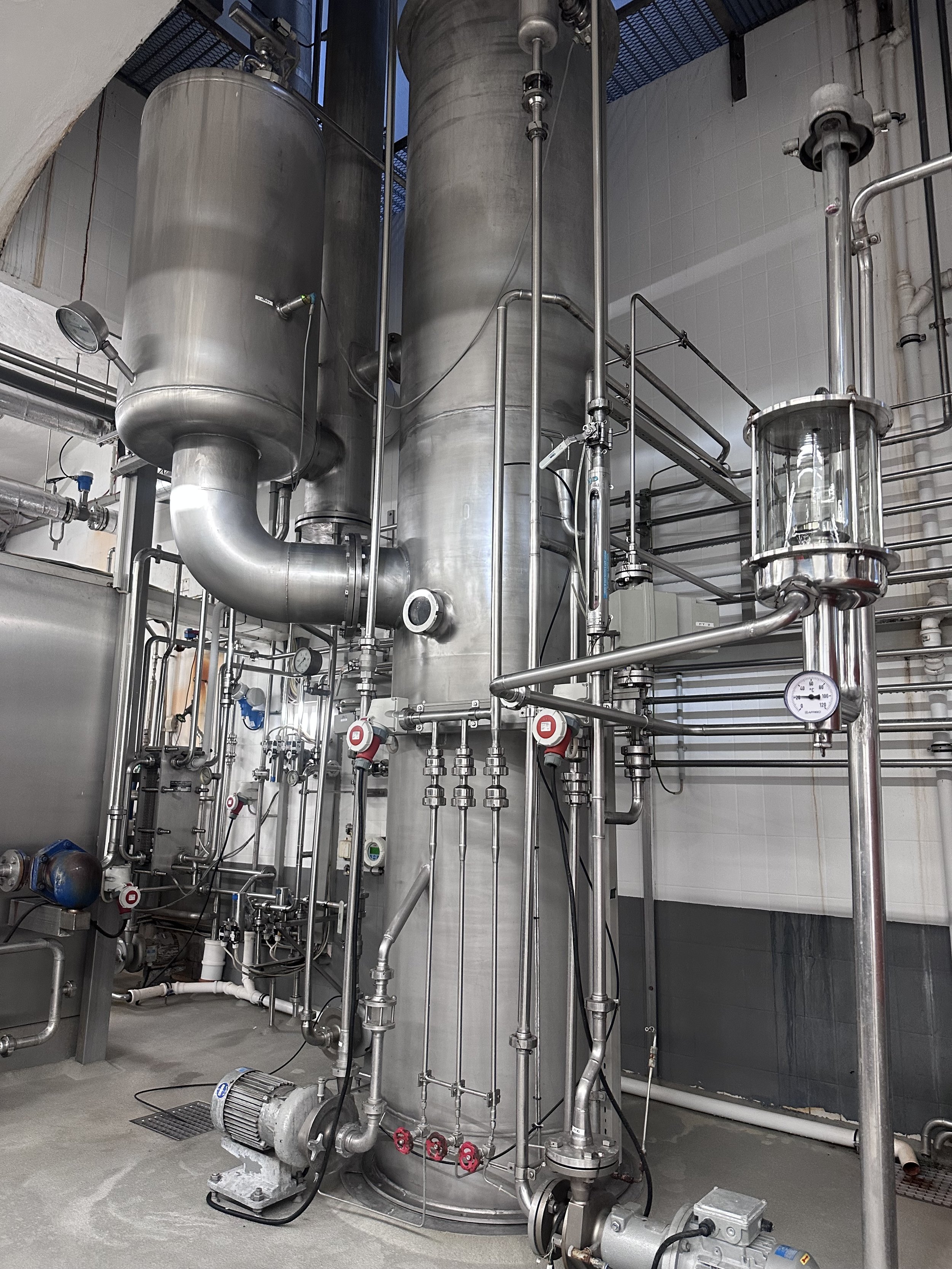
Germany has been a pioneer of de-alcoholised wine—the best examples I’ve tried have been from Germany (Leitz are a particularly good example). We visited Carl Jung; he was a doctor from a winemaking family who first made de-alcoholised wine in 1907. It was met with some scorn, a reaction that persists and which I have to admit I share. He invented the vacuum distillation system, by which the aromas of a wine are separated from the alcohol and then added back to the non-alcoholic juice. The wines are often sweetened to add body and weight to a wine which would otherwise be quite dilute. The wines we tasted were perfectly fine, but they lacked interest or complexity: for better or for worse, alcohol is necessary to make wine (and other drinks) compelling. The most interesting wine was infused with tea leaves, which gave much more flavour than the other more “normal” de-alcoholised wines. Funnily enough, all that leftover alcohol is used to make brandy. As the family said on our visit, they’re not anti-alcohol, they just recognise that there are many people who want to drink wine without alcohol, which is fair enough.
sweetness
Believe it or not, we only tasted one sweet wine over the course of three days. I would have liked to tasted more, as it’s integral to Germany’s wine history, but it shows how much German wine has changed over the last thirty years. Although great sweet wines are still made, the emphasis is on dry wines, whether from Riesling or other varieties. Dry wines showcase their acidity, structure, texture, and site in a precise, emphatic way. Which is not to say they’re inherently better, but they do fit into international trends and demonstrate that German wine is more than just sugar.
wine laws
Gulp. German wine laws are an utter mess, and have been since they were introduced in 1971. They’ve been changed once again, though the changes won’t come into effect until 2030 (I think, it’s all rather confusing). Since 1995, the VDP, an independent organisation of the best 200 German producers, have strongly promoted dry, single-site wines to change perceptions of German wine, and have done it so successfully that their system is now being introduced across the country. The most important factor is single vineyard wines: Erstes Gewächs (the equivalent of Premier Cru) and Grosses Gewächs (Grand Cru). The problem is mapping out all the vineyards and deciding what status they deserve, which is why it’s going to take several years for these designations to come through. What these new wine laws also do is remove the Grosslage term, which referred to sites which could be over 1,000ha and yet would carry a single-vineyard name (they’re now referred to as a “Region,” for instance Region Piesport; except a Region can also refer to a sub-region…).
It’s an improvement. Does it make it simpler? Absolutely not.
red wine
Spätburgunder (Pinot Noir) has been made in Germany for centuries, but it’s only in the last 30 years that it’s come to international prominence. Now, 31% of German wine is red, although that’s a slight decline from the 37% peak a decade or so ago. Spätbugunder is made all over the country, and is generally of very high quality: earthy, herbal, bright red fruits, sometimes a little too green (that partly depends on whether the producer is using whole clusters). Ahr is the most northerly region and therefore the coolest, but the dark volcanic soils aid ripening. Baden is the most southerly and therefore the warmest, for riper styles. Those are the two best known regions, but it’s made elsewhere too.
Kloster Eberbach, in Rheningau and the oldest winery in Germany (founded by Cistercian monks in 1136) make legendary Spätburgunder from the village of Assmannhausen: Höllenburg is the oldest existing site in Germany, dating back to 1740—we also tried a wine from Weingut Allendorf. There’s also Adams Wein, where Simone Adams took over winemaking at her family winery in Rheinhessen in 2011, and it’s now farmed biodynamically. The Pinots are just wonderful, smoky, light, delicate, and elegant.
sekt, korreckt!
The last time I visited Germany, I wrote about all the Sekt I tried and I tasted some more great examples this time again. Germans drink more sparkling wine per capita than any other country, but a lot of it is terrible: carbonated wine made from grapes grown across Europe. But the quality of regionally-designated Sekt has been steadily rising, and now most of the top producers make wonderful sparkling wine, usually from Riesling. It’s a unique style of wine; made the same way as champagne, but from a much more aromatic variety in Riesling, as well as Pinot Noir. These wines are available internationally, but it’s only when visiting Germany you get to experience the whole range of quality Sekt: hopefully that changes as people discover the quality of the wines.
chardonnay
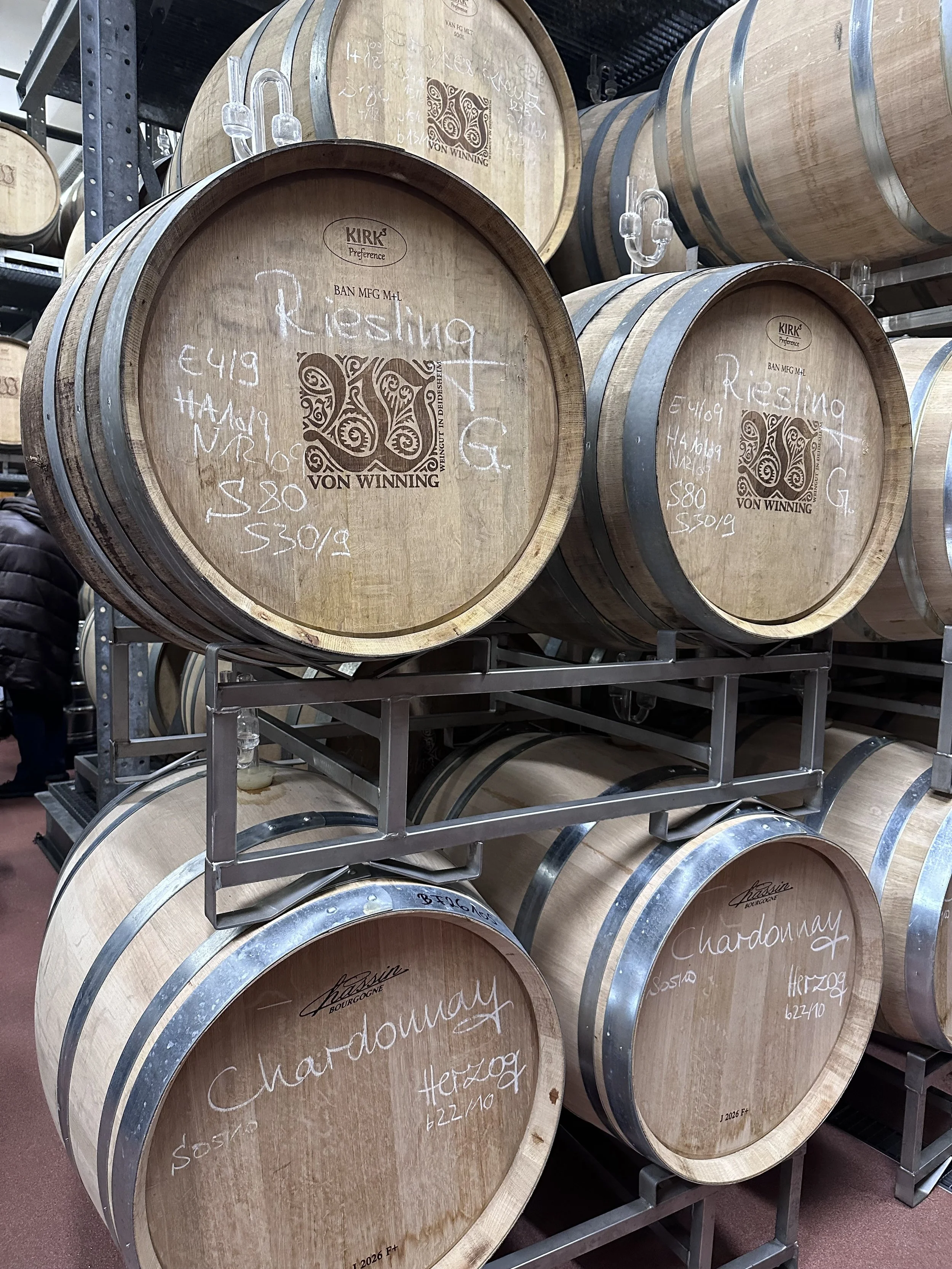
It may seem boring: yet more regions producing Chardonnay. It’s already everywhere, so why bother? But German Chardonnay is fantastic, and comes in a range of styles. It’s just a fact that Chardonnay allows winemakers to truly express their vision and interpretation of where the wine comes from. There’s crisp, Chablis-like Chardonnay; there’s rich, round Chardonnay reminiscent of Pouilly-Fuissé. Comparisons with Burgundy only go so far, however; these wines are German, with high, racy acidity, a gentle fruitiness, but very different from Riesling. These wines are available internationally, but for the most part you’re going to have to go to Germany to seek them out. A good reason to go to Christmas markets, have some goose, and a bottle of Chardonnay.
sauvignon blanc
German Sauvignon Blanc is fantastic: it might even be my favourite German wine. There, I’ve said it. There’s just a wonderful crispness to the wines underpinned by an earthiness quite typical of German white wines. Von Winning make two Sauvignon Blancs which are excellent examples of the range of Sauvignon Blanc made in Germany.
hybrids (PIWI)
Germany has a long tradition of creating hybrid varieties to withstand the cold growing conditions. More have emerged recently, and are seen as being a potentially large part of the future of German wine. We tasted 14 examples, with very mixed results. Cabernet Blanc is a crossing of Cabernet Sauvingon and Regent; green bell pepper was the dominant aroma—not something I want in sparkling wine. Souvignier Gris, a crossing of Seyval Blanc and Zähringer, was more convincing, the Sekt tasting like a decent Crémant. There are also aromatic hybrids, which aren’t really my style but which were perfectly fine: Calardis Blanc is a crossing of Calardis Musqué and Seyve Villard 39-639 (if that means anything to you); Sauvignac is a crossing of Sauvignon Blanc/Riesling and Riesling itself, which all feels very incestuous; Muscaris is a crossing of Solaris and Gelber Muskateller. At this point, I gave up writing tasting notes. If this is part of the future of German wines, it’s neither exciting nor romantic.
riesling
Think Germany, think Riesling: it makes up 21% of all plantings. My favourite line-up of Rieslings was at Korrell, where we tasted nine wines from along the Nahe river. Many of these wines are fermented and aged in large, 600l litre oak barrels, which gives them a round richness. The wines were a good example of how Riesling is not just one thing: for Korrell, the wines are powerful and creamy, in other cases they’re lean and acidic. In all cases, they express exactly where they’re from and the personality of the winemaker.
generation riesling
Generation Riesling is an organisation which promotes producers under the age of 35. We got to meet three producers; ironically, not all the wines are made from Riesling. Bamberger make excellent Sekt from both Spätburgunder and Riesling; Gröhl make Chardonnay and Spätburgunder as well as Riesling; while Robert König, based in Assmannhausen, make exceptional and very affordable Spätburgunder. It’s wonderful to experience the future of German wine. This is a country of tradition, but also of innovation.
The history of Germany is defined by war and conflict; it’s also defined by great wine—let the latter continue.